

Why I’m building a brain-computer interface in Turkey
Written by Yasin TANIŞ
Editor’s note: our founder Yasin Tanış wrote this piece on Medium in January 2026. It is about CerebrAI-VortX, a separate company he founded; NeuroFlow is a CerebrAI-VortX product, not an OMNIA-XSI product. Figures and plans reflect his view at the time of writing.
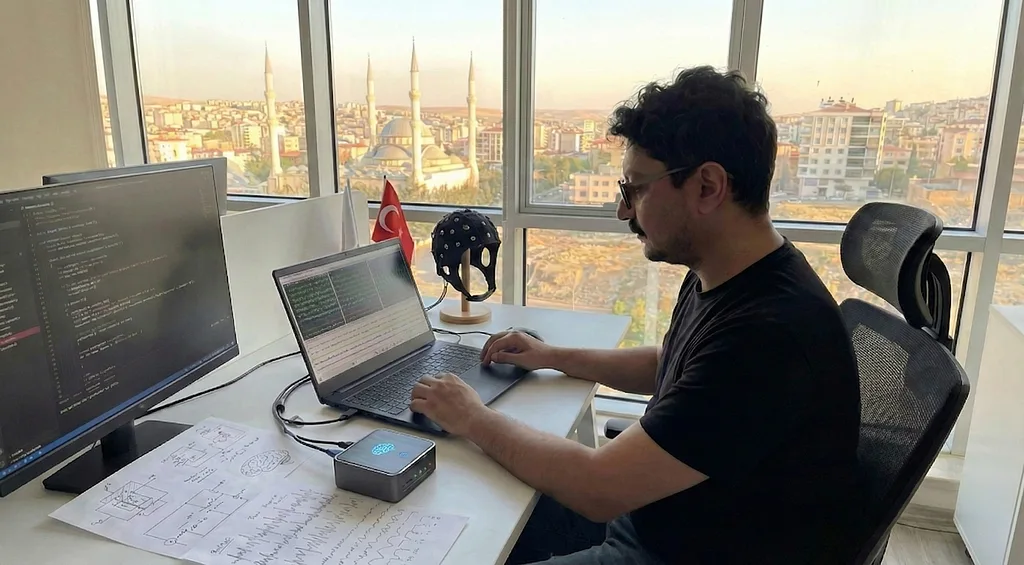
A founder’s journey from Şanlıurfa to the frontlines of neural technology
In August 2024, I made a decision that many thought was premature, perhaps even reckless: I founded CerebrAI-VortX, a brain-computer interface company focused on restoring communication for people with speech impairments. We’re not in Silicon Valley. We’re not backed by marquee venture capital. We’re building from Şanlıurfa, Turkey, a city not usually associated with cutting-edge neurotechnology.
Eighteen months later, with our NeuroFlow system reaching 94.3% accuracy in converting EEG signals to Turkish text with under 2 ms latency, I’m more convinced than ever that this is exactly where this technology needs to be built.
Let me tell you why.
The moment that changed everything
My journey into BCI technology didn’t start with a fascination for neural engineering or artificial intelligence. It started with a simple, uncomfortable truth: most assistive communication technology is built for English speakers by teams in wealthy countries. If you have ALS, cerebral palsy, or a stroke that affected your speech, and you speak Turkish (or Arabic, or Urdu, or any of dozens of languages), your options are limited, expensive and often inadequate.
I saw this firsthand through my work with the Beyazay Association, one of Turkey’s leading disability rights organizations. I met people whose minds were sharp, whose thoughts were complex, who had so much to say, but whose voices had been taken by illness or injury. And I saw how existing solutions, designed for Western markets and English-language contexts, fell short of their needs.
That’s when I realized: this isn’t just a market opportunity. It’s a fundamental question of equity and access.
What the world gets wrong about building in emerging markets
When I tell people I’m building a BCI company in Turkey, I often get a certain look. The unspoken question is always the same: “Shouldn’t you be doing this in Boston or San Francisco?”
Here’s what that question misses.
1. Linguistic diversity creates technical moats
Turkish is not just English with different words. It’s an agglutinative language with entirely different grammatical structures, phonetic patterns and computational challenges. Signal processing architectures that work for English don’t simply carry over. BioBERTurk, trained on Turkish medical publications, reaches 95.1% accuracy on Turkish healthcare NLP tasks precisely because it was built for this language.
When we trained our models on the TurkMedNLI dataset and fine-tuned them on 167,732 Turkish patient-doctor Q&A pairs, we weren’t just localizing a product. We were solving fundamentally different technical problems, and those solutions become our competitive advantage.
2. Emerging markets demand cost-effective innovation
The average BCI implant developed by US companies costs hundreds of thousands of dollars. For most of the world, that isn’t a price point; it’s a fantasy. Non-invasive approaches using consumer-grade EEG hardware aren’t a compromise; they’re a necessity. And that constraint drives innovation.
Our NeuroFlow-Premium NF-P9 device is designed for manufacturing at scale, for deployment in resource-constrained health systems and for maintenance by local technicians. These aren’t bugs; they’re features that make the technology usable for the 99% of the world that isn’t wealthy.
3. Regulatory pathways in associated countries create strategic advantages
Turkey’s position as a Horizon Europe associated country means we can access EU funding programs, such as the EIC Accelerator’s €2.5M grants plus up to €15M in equity, while building in a market with faster regulatory cycles than the US or the EU. CE marking opens Turkey, the whole EU and much of MENA. We’re not geographically disadvantaged; we’re strategically positioned.
The technical challenges no one tells you about
When I decided to leave traditional career paths and focus full time on CerebrAI-VortX, I knew it would be hard. I didn’t know it would be this hard.
The hardware gauntlet
Getting OpenBCI hardware into Turkey isn’t just expensive; it’s an exercise in patience and persistence. Import rules, customs delays and the technical complexity of certifying non-invasive medical devices create barriers that well-funded US startups never think about. We’ve spent months on procurement processes that would take weeks in California.
But every barrier teaches you something. We’ve become experts in sourcing, in supply-chain resilience, in building relationships with manufacturers who can deliver the quality we need. These aren’t distractions from “real work”. They’re core skills for building medical devices at scale.
The talent puzzle
Turkey has exceptional engineers and data scientists. I know because I trained with Miuul, completed the DataCamp Data Science career track and competed as a TEKNOFEST finalist in natural language processing. The talent exists. But a team with combined expertise in neuroscience, signal processing, machine learning and hardware engineering? That means creating the roles, not just filling them.
We’re not hiring people who have built BCIs before (there aren’t many in Turkey). We take brilliant engineers and teach them neuroscience. We take data scientists and teach them about EEG artifacts and motor cortex activation patterns. It’s slower. It’s also how you build deeply cross-functional teams that understand the full stack.
The funding marathon
Venture capital for medical devices exists in Turkey, but it’s nothing like Silicon Valley. The seed round we can raise is a fraction of what a comparable company would raise in the US. That means we have to be more capital-efficient, more creative with non-dilutive funding (TÜBİTAK BiGG, KOSGEB, EIC Accelerator) and more patient.
What I’ve learned: capital efficiency creates discipline. When you can’t afford to pivot every six months, you get very good at validating assumptions before committing resources. When you can’t outspend competitors, you have to out-execute them.
Why 2025 was the turning point
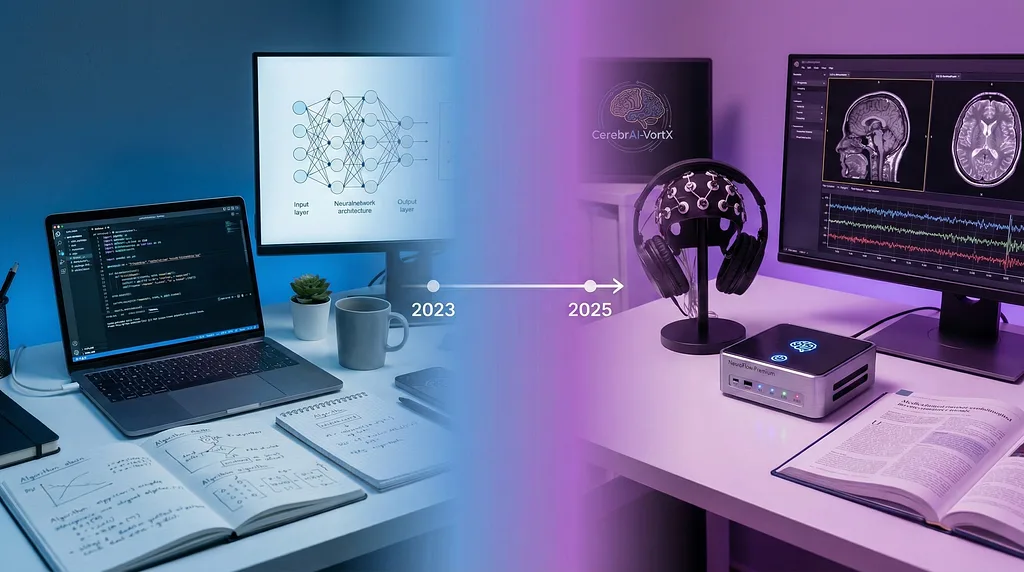
For the first two years of building CerebrAI-VortX, I often felt we were early, maybe too early. The technology worked in labs but hadn’t broken through commercially. Investment was cautious. Regulatory pathways were unclear.
That changed fundamentally over the past 18 months.
The technical proof points are here
UC Davis published research showing 97% accuracy in decoding neural signals for speech. Stanford demonstrated real-time recognition of inner speech. These aren’t incremental improvements; they show the technology is ready for clinical use. When your own research shows 94.3% accuracy with under 2 ms latency, you’re not building science fiction. You’re building a medical device.
The regulatory pathways are defined
In 2025 the FDA granted breakthrough device designations to Neuralink and Paradromics specifically for speech restoration. Precision Neuroscience received the first 510(k) clearance for a next-generation BCI. The European Accessibility Act took full effect in June 2025, creating compliance requirements, and market opportunities, linked to the roughly 100 million people with disabilities in the EU.
This isn’t a speculative future anymore. It’s now.
The investment is flowing
More than $1 billion has gone into BCI companies over the past 18 months: Neuralink $650M, Synchron $200M, Precision $102M. AI-enabled health tech startups command an 83% premium in funding rounds. The capital is there for companies that can show clinical validation and a path to market.
The market is expanding
The BCI market, valued at $2.9 billion in 2024, is projected to reach $12–15 billion by 2033–2035. The assistive communication device market alone is growing about 11.5% a year. More importantly, the market is going global. Support for languages other than English is becoming a competitive requirement, not a nice-to-have.
What we’re building toward
When people ask me about CerebrAI-VortX’s vision, I don’t talk about quarterly metrics or Series A valuations. I talk about three people.
Mehmet lost his ability to speak after a stroke, but his mind is still sharp. He has decades ahead of him but is locked inside a body that won’t cooperate. He deserves to talk with his grandchildren in Turkish, not through an English-language system that approximates his thoughts.
Ayşe is a young woman with cerebral palsy who wants to be a journalist, but her speech impairment makes ordinary conversation exhausting. She needs technology that keeps up with her thoughts instead of slowing her down to the pace of eye tracking or switch scanning.
Emre has ALS and is watching his voice fade month by month. He wants to record messages for his children while he still can, in his own words, in his own language.
These aren’t abstractions. These are the people who deserve this technology, and they’re why I work 80-hour weeks, why I’ve put everything I have into this company, why I said no to comfortable corporate jobs.
The road ahead: challenges and opportunities
I’m not naive about what comes next. The challenges are substantial.
Clinical validation is expensive and slow
We need partnerships with Turkish university hospitals. We need to run clinical trials. We need to generate the data that regulators and payers require. That takes years and millions of dollars. But it isn’t negotiable: the only way forward is rigorous, methodical clinical validation.
Manufacturing at scale requires capital
Our technical drawings for the NeuroFlow-Premium NF-P9 are complete and our bill of materials is final. But going from prototype to production needs manufacturing partners, quality systems and capital. We’re pursuing this through a mix of public funding (TÜBİTAK, KOSGEB), European grants (EIC Accelerator) and strategic angel investors.
Market education is a marathon
Most people, including many healthcare providers, don’t yet understand what BCIs can do. Building awareness and trust and creating demand takes consistent education and demonstration. That’s why content matters, why conference talks matter, why every clinical partnership is also a chance to teach.
Reimbursement pathways must be established
Reimbursement by Turkey’s SGK (Social Security Institution) is critical for adoption at home. International markets mean navigating different health systems and insurance structures. The good news: in 2024 Neurolutions received the first CMS procedure code for a BCI device, proving the pathway exists. We need to follow it.
Why I’m sharing this
I’ve been away from Medium and LinkedIn for almost a year. It wasn’t writer’s block or a lack of material; it was the opposite. I was so deep in the work of building that I stopped documenting the journey.
That was a mistake.
One responsibility of building in an emerging market, in an emerging technology field, is to make the journey visible. Every founder who builds in Turkey makes it a little easier for the next one. Every technical challenge we solve and share becomes a resource for the community. Every investor conversation we document helps others sharpen their pitch.
So this is the first of what I hope will be many updates on building CerebrAI-VortX. Not only the wins (there will be some), but the challenges, the setbacks and the lessons learned the hard way.
Because if we succeed, and when we succeed, it won’t be about one company or one technology. It will show that world-class innovation can come from anywhere, that emerging markets can lead in frontier technology, and that the future of healthcare isn’t being built only in California and Massachusetts.
It’s being built in Şanlıurfa too.
What I’m asking from you
If you’ve read this far, you’re someone who believes in ambitious missions and unconventional paths. Here’s how you can help.
If you work in healthcare: help me understand your challenges with assistive communication technology. What works? What doesn’t? What would really make a difference for your patients?
If you’re an investor: let’s talk. We’re building a company with real technical differentiation, a large underserved market and a clear path to clinical validation.
If you work in research or regulation: share your insights. We’re in new territory, and any guidance on clinical trial design, regulatory pathways and academic partnerships helps.
If you’re a founder: reach out. Building in emerging markets is hard, but we don’t have to do it alone. Let’s share what we learn, make introductions and support each other.
And if you need this technology, or know someone who does, stay in touch. You’re why we’re building.
Yasin Tanış is the founder and CEO of CerebrAI-VortX, a health technology startup developing brain-computer interface technology for people with speech impairments. He is also a board member of the Beyazay Association, one of Turkey’s leading disability rights organizations. You can connect with him on LinkedIn.
What emerging technology challenges are you working on, and which unconventional paths are you taking? Share your story under the original post on Medium; he reads every comment.